Medical Office Management
A weekly review that turns open loops into next steps
A practical way to review unfinished work, clarify ownership and prepare for the week ahead.

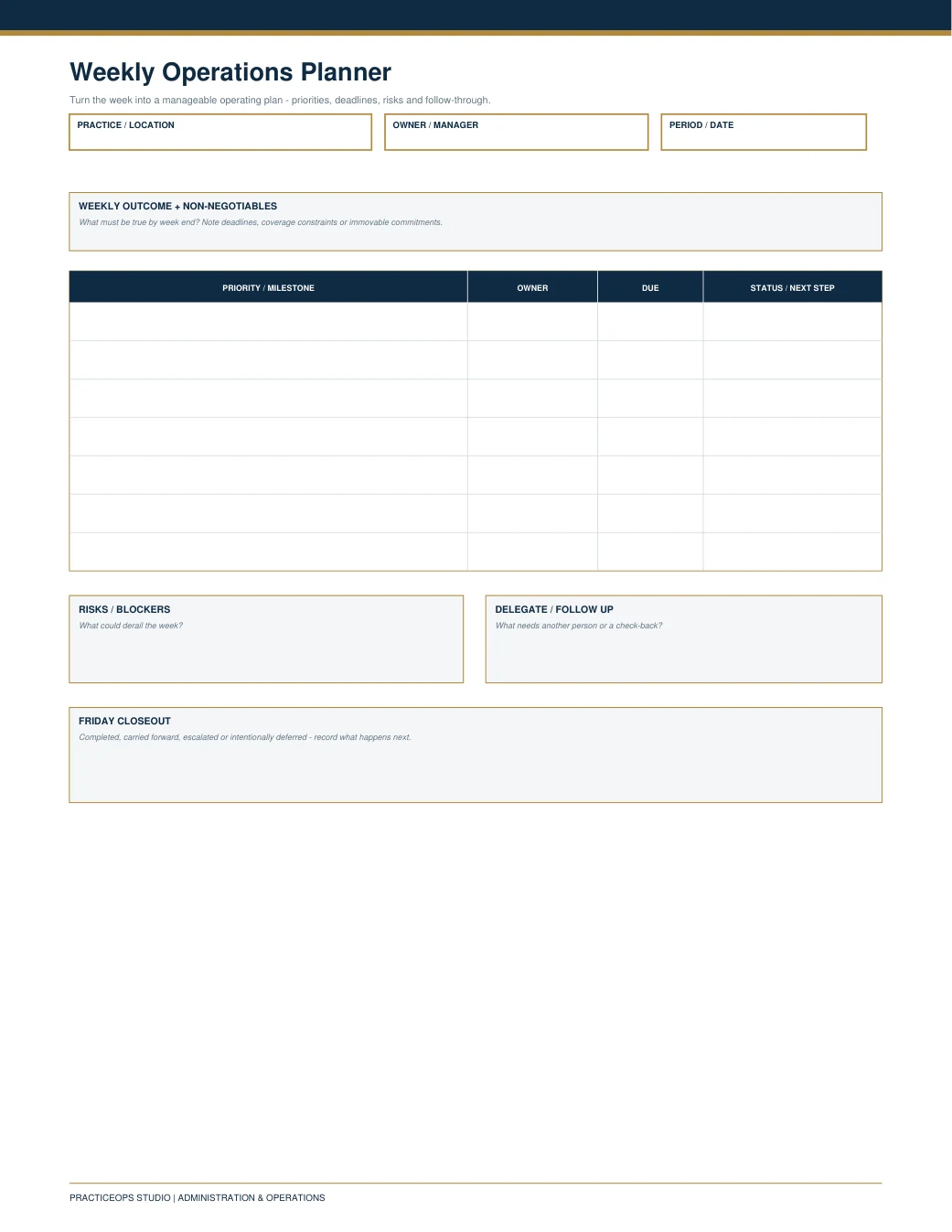
Start with the work that is still open
A weekly review gives a medical office manager a deliberate moment to look across the work. The aim is not to repeat every conversation or write a report about everything that happened. It is to decide what needs attention next, who owns it and when to check back.
Begin with the records you already use: an action list, meeting notes, a coverage plan and a log of operational issues. Look for commitments that are unfinished, waiting for a response or no longer realistic. Keep patient details and sensitive personnel information in your organization’s approved systems. Your management review can refer to the operational task without copying the underlying record.
Choose one place for the review’s next actions. If the same task appears in several notes, identify the authoritative entry and update it there. A review is easier to maintain when it produces a short, useful set of decisions rather than another competing list.
Review six questions in order
Work through the questions below using the evidence available to you. A missing update is itself something to resolve; it is not proof that a task is complete.
- What was completed, and what evidence confirms it?
- What remains open, and is the next action still clear?
- What is waiting on someone else, and when will we check back?
- What changed in coverage, deadlines or priorities?
- What requires a manager’s decision before the team can move forward?
- What repeated enough to deserve a separate improvement conversation?
Write actions someone can carry out
“Fix supply issues” is a topic. “Confirm the reorder quantity with the supply owner by Tuesday” is an action. Use a concrete verb, an owner and a date. Add the expected result when it would otherwise be ambiguous.
For example, an office may have a recurring problem with supplies arriving after the team expected them. The weekly review does not need to settle the entire purchasing process. It can assign an owner to compare the existing reorder point with the ordering schedule, then bring a proposed change to the next check-in.
Avoid treating a due date as the only information that matters. Record what is blocking the task and what help is needed. If an owner cannot act because another person must decide, make that decision request visible. This keeps the review focused on the actual next step.
Separate routine follow-up from improvement work
An isolated exception may only need a follow-up action. A recurring exception may need a closer look at the workflow. Keep those two responses distinct so every small issue does not become a project.
For a repeated problem, capture the observed pattern, the information you still need and a small change you could test. Decide who will coordinate it and when to review the result. Do not declare a cause before you have enough evidence to support it.
A scheduling handoff, for instance, might repeatedly arrive without a clear owner. Your first test could be to add an owner field to the handoff record and check whether the next several handoffs contain it. The review can then decide whether to keep, adjust or stop that change.
Carry forward deliberately
Before ending the review, inspect each open item. Keep it active with a clear next step, move it to a later planned review, or close it with the reason recorded. An item should not disappear simply because the week changed.
Build the coming week around a small set of priorities and known constraints. Leave room for reactive work rather than treating every available hour as committed. If a priority depends on a person who is unavailable, revise the plan before it becomes a missed deadline.
End by sharing only the decisions the relevant team members need: the action, owner, timing and any changed expectation. Keep the detailed review where you can find it later. At the next review, start with those commitments instead of reconstructing the week from memory.
Try it with one real workstream
For your first review, choose a single operational workstream such as supply ordering, staff training completion or outstanding vendor questions. Gather its open items and make each next action explicit. Add other areas only when the routine is useful enough to sustain.
You do not need a new tool to begin. A simple list with item, owner, next step and review date can be enough. If you already use a PracticeOps system, use its existing action and review pages rather than creating a parallel tracker. The value comes from making and following through on the decisions.
This article offers general operational organization ideas. Apply your organization’s approved policies, roles and systems. Do not use these tools to store patient-identifying information.
Explore free manager resources